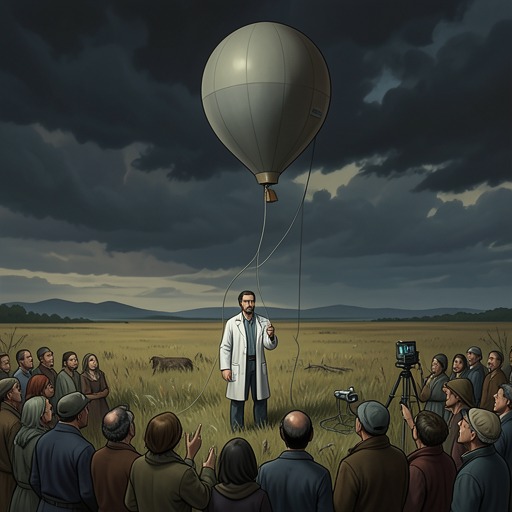
High-altitude balloon
Serious MenThe High-altitude balloon turns Arvind Acharya’s argument about life arriving from space into a physical experiment. In the Balloon Project, it carries four sealed air samplers to an altitude of 41 kilometres, where they are opened to collect samples. The discovery of a rod-like bacterium and a fungus in material collected there makes the balloon more than a vehicle: it becomes the instrument through which Acharya’s disputed idea gains material evidence, without making the origin of that evidence certain.
Design and Scientific Purpose
The balloon’s purpose is to take sterilized samplers high above Earth and bring captured air back for analysis. At a press briefing, the Institute of Theory and Research’s Press Officer described the devices as steel samplers opened by remote control at a chosen altitude. The flight’s target was 41 kilometres. Acharya’s reasoning was that life found there would be coming down rather than rising from Earth’s surface, although the altitude alone could not establish where a particular organism had originated.
The project’s extraordinary scale is measured against the smallness of its payload. Acharya imagined a balloon twenty storeys high, with the gondola holding the four sealed samplers hanging like a tiny tip beneath it. He was struck by the physical disproportion: the basket carrying the experiment’s reason for being seemed hundreds of times smaller than the balloon. But the contrast also unsettled his own expectations. The balloon was a physical device, while its purpose—the search for evidence of alien life—was abstract; size could not make those two things commensurate. He connected this mismatch to a larger possibility he privately entertained: that the universe, vast in its physical dimensions, might produce minute forms of life and consciousness.
From Dormant Equipment to Balloon Project
After Acharya spoke about the mission at The Talks, activity accelerated in the Institute’s basement. Dormant machines, boxes and borrowed research hands were put to work, and the laboratory became the Institute’s busy centre. Acharya began arriving before nine in the morning, followed by research assistants. Old colleagues came from different parts of the world to help for short periods, turning work on the balloon into a temporary reunion as well as a research effort.
The team even discussed what to call the mission. When someone suggested that it needed a name, Acharya treated the suggestion seriously, paused, and proposed Superman. His laughter shook his paunch hard enough to snap a button. The group eventually settled on the more practical name Balloon Project, sometimes shortened to BP. The naming episode gives the apparatus a place in the group’s shared work: it is not only a costly scientific device, but the focus of renewed collaboration and a rare, relaxed moment for Acharya.
Launch, Collection and Analysis
In the first week of November, the balloon flew over Hyderabad with four samplers aboard. The accounts describe the collected material being divided among laboratories: three samplers went to laboratories in Boston and Cardiff, while the last arrived at the Institute in a Toyota Innova. The press briefing specified that two had gone to Cardiff and one to Boston. The Institute’s sampler was studied in its Astrobiology lab by Oparna Goshmaulik’s research hands and two American scientists who were old friends of Acharya. Their work took place in isolation from the rest of the Institute, and they gave no word until the analysis was ready.
Oparna emerged from the basement laboratory carrying handwritten results bound with a cord. Her conclusion was that living cells had been found at 41 kilometres: spores of a rod-like bacillus and of a fungus identified as Engyodontium albus de Hoog. When Acharya heard the news, he shut his eyes for so long that the visitors left without a word, smiling. The finding confirmed that living material had been recovered from the sampled air; it did not, by itself, settle how the organisms had reached that altitude or prove that they came from outer space.
Evidence, Uncertainty and Dispute
At the press conference, Acharya presented extraterrestrial origin as a reasonable inference, not a conclusion. He pointed to the difficulty of explaining how bacteria and fungi could be present at that height, while noting that the chance of organisms surviving there through debris from defunct satellites was very small. When a reporter raised possible laboratory contamination, Acharya replied that precautions had been taken and that the discovered organisms were rare and difficult to culture in laboratory conditions. These points supported the interpretation without eliminating the need for scrutiny; the remaining samplers were still being studied elsewhere.
The balloon also stood at the centre of a dispute over what research the Institute should pursue. Arvind Acharya refused to let the Giant Ear be used for the Search for Extraterrestrial Intelligence, which he dismissed as a search shaped by human loneliness and a narrow assumption about what life might be. Jana Nambodri, by contrast, argued that even a mathematically possible discovery justified a search for truth and that scientists should not reject the possibility merely because it was remote. Their disagreement exposed competing claims about scientific legitimacy, institutional resources and authority. Acharya’s Balloon Project advanced his own account of life’s cosmic origins, while his opposition to radio searches made clear that he did not treat every search for extraterrestrial life as equally scientific.
The results gave Acharya’s proposal that life on Earth first arrived as microscopic organisms from space new support. They did not erase the distinction between evidence of living cells at 41 kilometres and proof of their extraterrestrial origin; instead, they made that distinction consequential. The balloon carried a test of a bold hypothesis into the atmosphere, and the organisms recovered from its samplers left the boundary between alien and terrestrial life newly uncertain.